

The Anthroposophic Medicine Education Program
A Pathway of Development and Lifelong Learning
A continuously offered three-year curriculum that transforms how you understand the human being, illness, and healing.
Designed for physicians and other licensed prescribers, the Anthroposophic Medicine Education Program combines in-person events, live webinars, group mentoring, and independent study into a flexible and ongoing educational journey.
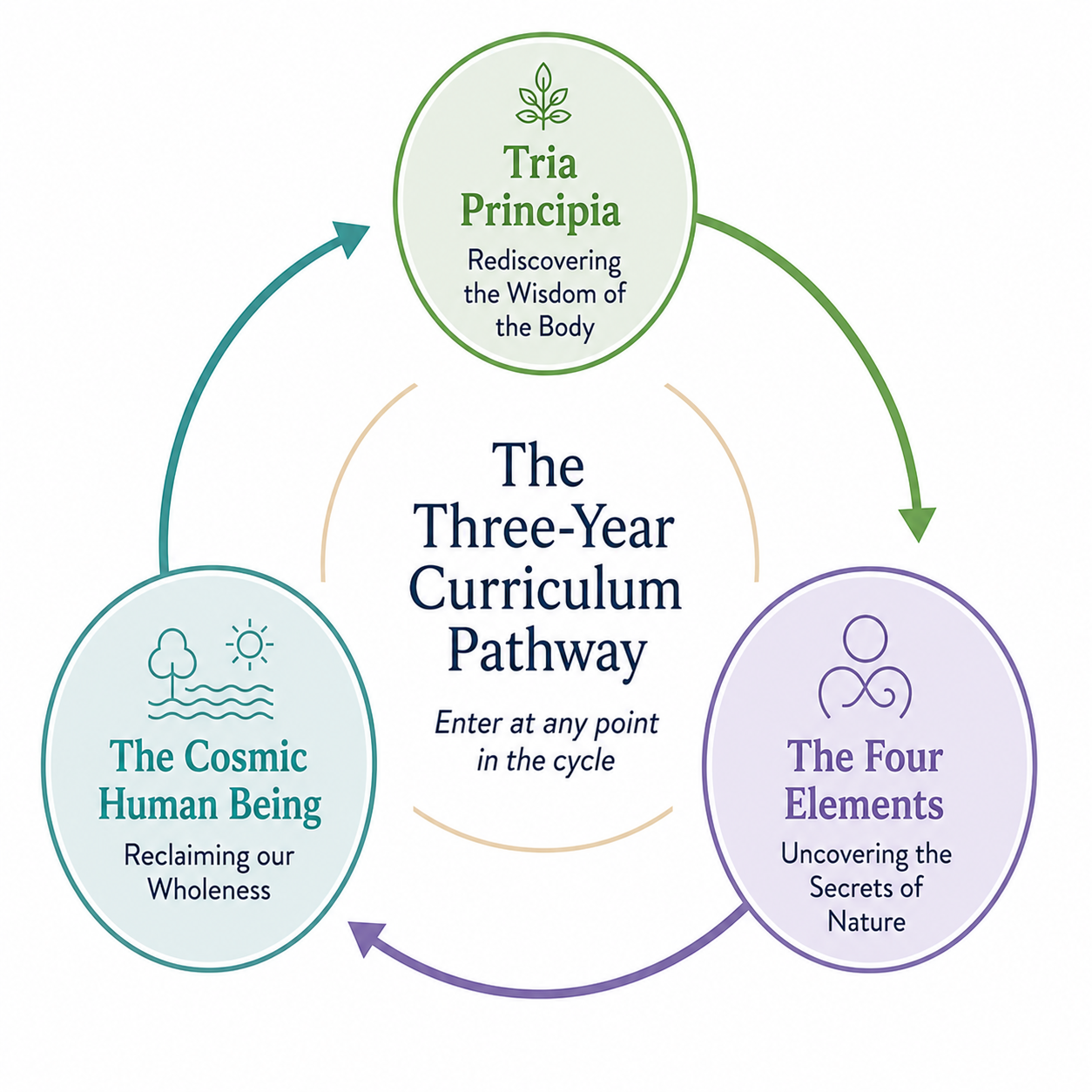
The pathway is built around three curriculum themes. Participants may enter at any point in the annual curriculum cycle, complete all three curriculum themes over time, earn Continuing Medical Education (CME/CE) throughout the program, and, if desired, pursue certification through the Physicians' Association for Anthroposophic Medicine.
Year 1 – November 2026 – June 2027
Tria Principia: Rediscovering the Wisdom of the Body
The first year explores the threefold organization of the human being and its application to clinical observation and practice. Through immersive study, clinical prescribing, group mentoring, and experiential learning, participants begin developing new ways of observing patterns of health and illness and translating those observations into clinical practice.
Each year begins with a multi-day Physicians’ Fall Retreat that serves as the gateway into that year's curriculum theme. This retreat focuses on experiential learning with minimal lecture time. Instead, clinicians bring their presence and openness to discovery. Short “seed talks” are given to introduce a theme, followed by observation exercises, artistic activities, small group work, time for reflection, and meaningful conversations with faculty and colleagues.
Following the retreat, participants continue learning throughout the year through live prescribing webinars, online group mentoring, independent study, and clinical mentorship. Those who are new to Anthroposophic medicine will be given access to the 10-lecture Foundations introductory series.
The final event of the year is the Summer Intensive. For 2027, this event will be an Interdisciplinary Anthroposophic Healthcare Conference that will engage participants in plant observation, artistic activities, case studies, and a celebration of the Healing Plant Garden.
Physicians' Fall Retreat
November 5–8, 2026
The Physicians' Fall Retreat offers an opportunity to slow down, deepen our powers of observation, and cultivate new capacities of perception that enrich anthroposophic diagnosis and treatment. Through experiential exercises, reflection, and conversation, participants explore new ways of understanding disease processes, constitutional diagnosis, and therapeutic possibilities.
Designed for busy clinicians, the retreat creates space to step away from the demands of daily practice and engage in a slower, more attentive process of discovery. This shared experience lays the foundation for the year's clinical learning while fostering meaningful connections with colleagues in the Anthroposophic Medicine community.
Held at Mount Madonna Center in California, the retreat takes place in a beautiful natural setting that invites us to reconnect with nature, with one another, and with the deeper questions that inform our work as physicians.
Year-long learning: Online Clinical Education
Six 90-minute Prescribing Webinars
Continue the year's learning through our Thursday evening webinars focused on anthroposophic approaches to common conditions.
Threefold Headache (Nov 19)
Threefold IBS (Dec 3)
Threefold Insomnia (Jan 14)
Threefold Asthma & Eczema (Mar 11)
Threefold Food Allergies (Apr 8)
Threefold ADHD (May 6)
Two Online Group Mentoring Sessions
Bring clinical questions and cases into conversation with experienced clinicians and peers.
Thursday, March 4
Thursday, May 13
Summer Intensive: Seeds of the Future
June 16–20, 2027
This interdisciplinary Anthroposophic healthcare conference provides physicians an opportunity to expand their medical understanding by learning alongside other anthroposophic healthcare practitioners.
The intensive takes place in Camphill Village, Copake, New York where physicians engage in plant observation, artistic and movement activities, case studies, and a celebration of the Healing Plant Garden and the caring community within which it grows.
In learning to perceive the patient together, participants can both deepen their own practices and expand their capacity for therapeutic collaboration.
Foundations of Anthroposophic Medicine
10-lecture on-demand introductory series
New to Anthroposophic Medicine? This 10-lecture introductory course offers a foundation for understanding its distinctive view of the human being and how that perspective can deepen clinical observation and care.
Explore the core concepts of Anthroposophic Medicine at your own pace and begin to see how a deeper view of the human being can open new ways of thinking about health, illness, and healing.
Pricing Packages
Full Curriculum
Physician’s Fall Retreat
Six prescribing webinars
Two online group mentoring sessions
10-lecture Foundations series (for those new to Anthroposophic medicine)
Access to webinar recordings and related educational materials through AnthroMed
Complimentary access to Learner+, with opportunities to earn CME/CE through eligible Reflective Practice activities
PAAM membership included through January 31, 2028 (for non-members)
Note: Summer Intensive fee not included in this package. Requires separate registration.
Physicians’ Fall Retreat
3½-day immersive learning experience for physicians who want to deepen how they see, think, and care for patients.
Date: November 5-8, 2026
Location: Mount Madonna Center, California
Foundations of Anthroposophic Medicine
Ten on-demand lectures prescribing webinars. Explore core concepts of Anthroposophic Medicine through ten recorded presentations addressing philosophy, scientific methodology, the human being, diagnosis and therapy, pharmacy, development, and clinical practice.
Summer Intensive
4½-day conference where participants engage in plant observation, artistic and movement activities, case studies, and a celebration of the Healing Plant Garden.
Date: June 16-20, 2027
Location: Camphill Village, Copake, NY
Webinar Series
Six prescribing webinars
Threefold Headache (Nov 19)
Threefold IBS (Dec 3)
Threefold Insomnia (Jan 14)
Threefold Asthma & Eczema (Mar 11)
Threefold Food Allergies (Apr 8)
Threefold ADHD (May 6)

Education Outcomes
Establish a doctor-patient relationship based on observation and dialogue, in which you perceive the patient as an individual in a process of ongoing development
Take into account the spiritual dimension of the human being in the treatment plan and where appropriate, be able to discuss this with the patient
Establish a differentiated evaluation of the threefold and fourfold aspects of the patient, e.g. structural, physiological, emotional, and individual dimensions (also called the human fourfold nature)
Treat common diseases differently by including Anthroposophic findings, assessment, and/or treatment into your practice and adapt these over the course of illness
Develop a living connection with nature, as well as with the substances that are unique to Anthroposophic medicine
Understand the scientific foundations and research methods of Anthroposophic Medicine and independently search the Anthroposophic-medical literature
Years Two and Three Curriculum Themes
Year 2: The Four Elements
Uncovering the Secrets of Nature
Build upon the threefold perspective by exploring the physical body, etheric body, astral body, and I-organization as practical clinical realities. Learn how this expanded understanding informs diagnosis, individualized treatment, and the physician-patient relationship.
Representative topics include fever & acute inflammation, chronic inflammation & autoimmune disease, cancer prevention, urinary tract disorders, diabetes & metabolic syndrome, and depression.
Year 3: The Cosmic Human Being
Reclaiming our Wholeness
Integrate the broader relationships between the human being and the world, including growth & development, individual biography, the influence of the planets and fixed stars, constitutional therapy and long-term health. This curriculum theme brings together concepts developed throughout the program into an increasingly integrated clinical approach.
Representative topics include musculoskeletal and rheumatic disease, endocrine disorders, autism spectrum and developmental challenges, advanced therapeutics and complex clinical case integration.
Continuing medical education
Reflective Practice and CME/CE Credit
Many in-person events, webinars, online courses, and other activities within the Education Program provide meaningful opportunities for reflection.
Eligible participants may use these learning experiences as the basis for completing the certified Reflective Practice activity in Learner+. CME/CE credit is awarded for the participant’s completed reflection—not for attendance or educational content.
Through Learner+, participants may earn credit while deepening their understanding of Anthroposophic Medicine, expanding their clinical perspective, and considering how their learning applies in practice.
Continue Toward Certification
Certification is available through PAAM for physicians, nurse practitioners, physician assistants, dentists, and pharmacists who wish to demonstrate advanced competency in Anthroposophic Medicine. Certification for NDs is available through SPAN.
Completion of the AM Education Program and the Clinical Mentoring Program fulfills the training requirements for certification, while additional requirements include written case studies and independent work. Certification connects providers with an internationally recognized community of Anthroposophic physicians and healthcare practitioners.

Ready to Begin?
Whether you are discovering Anthroposophic Medicine for the first time or seeking to deepen an existing practice, the 3-year Education Program offers a flexible way to participate.