
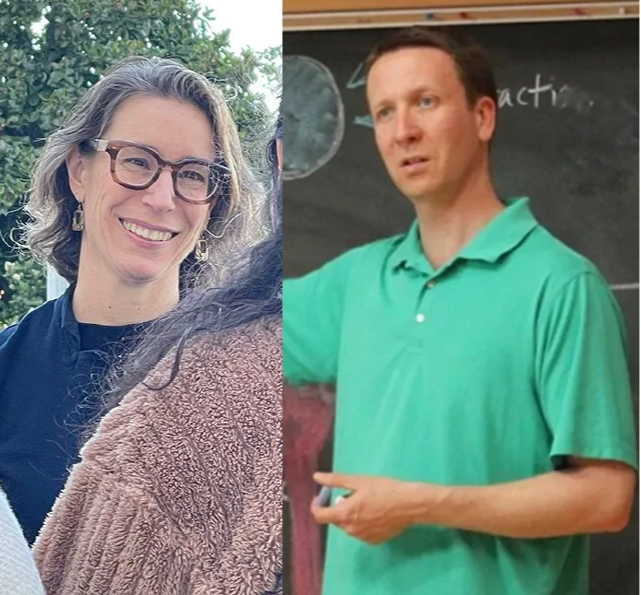
Adam Blanning, MD, and Carmen Hering, DO, reflect on clinical observation, the nature of learning, and what physicians may be missing in the practice of medicine today.
Following the 2026 Physicians’ Fall Retreat, we sat down with its two faculty members to explore what surprised them, challenged them, and stayed with them.
The conversation took us well beyond the retreat itself, raising a fundamental question: In a profession that places such value on the acquisition of knowledge, how do physicians cultivate the capacities that allow them to see and think differently?
PAAM: What emerged from this retreat, from the conversations that you had, that you had not anticipated, that surprised you or challenged you in some way?
Carmen Hering: That's a very rich question for me because there was a lot that surprised me.
I would start off with how surprised I was by how tired participants were. There was a level of fatigue, and it wasn't just an outward physical exhaustion. I think there was some of that, but there was a kind of mental fatigue that I really experienced with people.
And I saw how hard it was to really enter into a phenomenological study, to really be able to observe and to peel away prior knowledge, experience, associations, to really just be in the process of observation and experiencing something new.
That was really hard.
And I knew it was hard, but this was a group of very experienced physicians. This is a group of people who've been studying Anthroposophic Medicine for at least 10 years, with maybe just a couple of exceptions. So, for such an experienced group that has really lived into these ideas and has done a lot of experiential practices already, I was struck by this.
I felt like I learned a lot about what's happening right now in our culture and in our practice of medicine, and what is needed, I think, to really do this kind of work in a meaningful way.
PAAM: Adam, what would you say to what Carmen just brought up?
Adam Blanning: I think there were a lot of surprises. If I build on that and say it a little bit differently, it might be that people came in very full of their lives, their experiences.
Over the days, people got into the process more and more. And then at the end, some of them were really excited to say, “Okay, how do I apply this? How do I work with this now?”
It was a challenging process, but I think it was really rich. Looking at it in reflection, it got to a space that is pretty hard to experience or even be able to settle into. And probably the retreat setting was part of that.
I think the experience was a little bit different. If you just receive information and you parrot it back or echo it back or repeat it back, that happens on this pretty fast, everyday information level.
But for something to go in deeper, and then people say, “I'm really curious, could this be applied to…?”
We talked about hypertension, but then people were saying, “Could this threefold approach be applied to other things as well?” And the answer was, yes, of course.
It's not specific to one clinical field. It's not specific to one diagnosis. But it's something that you don't instantly apply to all situations. I think you have to consider the dynamics and see how it would fit in each place.
We were able to say, well, there are webinars coming up that will do this in more detail. But some people said, “I wish we could stay for more days.”
PAAM: Carmen, I want to go back a little bit to what you were saying about how tired people felt. Do you think that had to do with just the nature of traveling and showing up? Or do you think it has to do with the world in which we live? I'm trying to get a sense of what you think caused this.
Carmen: I think it's connected to what Adam said in terms of this fullness or an over-fullness.
People are really used to having to respond quickly to changing situations. And there's not much time to really pause and consider and observe and really feel what's present in front of them.
There's this attunement to a kind of hyper-reactivity, always a need to respond and take action quickly, make decisions quickly. And so that creates a quickening and a very superficial level of consciousness.
This ability to peel away our own content, our own knowledge — and of course, as physicians, we pride ourselves in all that we know. We're holding so much all the time.
So this is especially difficult in these more technical fields, I think. There's a lot of self-emptying that's required when you're doing phenomenological activities. And that kind of carving out and creating space seems challenging.
PAAM: Were there any differences in perspectives among the physicians that led to any particularly interesting discussions?
Adam: An interesting place was in this threefold model, talking about the qualities of the system of the nerves and senses versus metabolism, digestion and limbs.
It felt like there were moments where people were trying to decide, which is the good one? Is it good to be a person who's strongly in your senses, or is it good to be a person who's strongly in your will and metabolism?
And trying to say, well, actually, they're part of all of us. And we kind of lean one way or the other.
It was a very different discussion than the usual diagnostic process where you say what's healthy and what's ill.
Thinking in a polarity was much more about recognizing that they're both really necessary. They both can be one-sided. They both can bring really good gifts, and they can bring illness if they're too strong.
And so that was a surprise also, that thinking in a spectrum or a polarity takes a lot of practice.
I thought that was really interesting, also because physicians always want to be correct and healthy. You want to be doing the right thing.
So it felt like, “Well, which one should I be in? Am I doing the right one or not?”
It was kind of a shedding of some things to try and really think differently, or feel differently, maybe.
PAAM: Carmen, did you see any differences in perspectives among physicians that led to interesting discussions?
Carmen: I would echo a lot of what Adam said. I thought it was interesting because we talk about polarity when we talk about the threefold. And that's one way to talk about polarity.
But culturally, we talk about polarity a lot right now. And we don't tend to mean a threefolding so much. We tend to mean more of a good-bad, right-wrong, good-evil.
And even though we had such an experienced group, I could see how it was such a habit to say, “Okay, there must be the healthy end and then the unhealthy end,” forgetting that, no, actually, both ends are where we go too far.
It's just such a habit. It's a concept that's so ingrained in us. And to keep working with it is work, is practice.
That really was interesting to notice. And people got quite animated around these ideas and around their own feelings about what was right or wrong.
PAAM: Looking back on the retreat, what conversations or observations or questions have stayed with you?
Carmen: One thing that I really experienced during the retreat and that has continued to resonate is this experience of fellowship and community.
Again and again, participants reflected on how meaningful it was for them to be together, and how much they really were enjoying getting to know each other and spending time together, and feeling kind of held and walking with each other in this very challenging world and profession.
That was very rich for people and really meaningful.
And I think I wasn't fully expecting how much that would be in the foreground of what people were taking away from the retreat.
Adam: I also have been wondering about some of these ways of approaching things where you're really trying to make your thinking flexible, like thinking in a spectrum.
You can explain it. You can give examples. But I don't know that it's something that you can just instruct.
People really have to do it. And how important it is to try it. Sometimes it's strange, and you have to not get distracted away from it.
I've thought before, if you're really going to try to bring an imagination to people, a picture that moves, you really can't do that in 10 minutes in a talk.
I think you need 45 minutes to even just start to describe it, and people journey with you a little bit.
And then realizing that to really do this with movement, to do this with sculpting with your hands, to do this with examining another person, to do this with conversation — you need days to get to that space.
PAAM: If you could continue one conversation from the retreat with a much larger group of physicians, what would it be and why?
Carmen: When I read this question, I was really thinking, what would that be?
And what came up for me is actually very much in line with what Adam just brought up. It was this idea of time, how much it takes time for people to really enter into a tempo and a field of experience and a mode of thinking.
The retreat had a lot of experiential activities. We brought a lot of rich observation exercises, and people needed more time.
Because it really does take time to slow down enough and to really live into processes.
It's not just information-driven. It's not just concepts, not just ideas.
Ideas can happen pretty quickly, but to actually sense activity, and then out of that perception come up with ideas and insights and concepts, that really is a process that takes time.
And if we rush it or push it in some way, we end up kind of slapping things on top of it, and then we kind of kill it too quickly. We don't give it enough time to really emerge on its own.
I really did feel like if we had maybe done a little less, had a little more time off for people just to walk and talk and reflect, and give it some more sounding space, then people could really start to come up with their own observations that would feel really fresh and new and stay with them.
I really wanted to see that experience flower, to go through this whole growth cycle, and to really appreciate that that takes time and that less really can be more.
PAAM: I want to follow up on that one in particular. You're reflecting on this in relation to the retreat, where people have committed a certain amount of time out of their normal day. And if your view is that people need time to enter in, that seems like a bigger message beyond the retreat.
How does a physician actually accomplish that in their day-to-day activity? Can they do that? Is there a way to do that? How is that possible beyond a retreat?
Adam: I think the reality is you have to carve out that time. You have to protect it somehow, which is really difficult right now.
There's something about going slower and deeper which I think is more lasting. That's the hope.
Sometimes I've been part of things where you do something, and then two days later people come and say, “You know, I'm still thinking about that.”
And that's the quality which is so different than, “I heard something, it made sense, and either I already knew it, or I remember some of it, or maybe I'll come back to that sometime,” but the content is pretty much gone.
Whereas people are thinking, “I'm still carrying that.” And it usually has this kind of openness to it: “I'm still trying to understand it or have a relationship to it.”
And that's pretty precious if that can happen.
Carmen: Can I just add something more?
We had these evaluation forms that people filled out, and that was very nice, and people mostly really loved it. But part of me would really like to send out an evaluation three months later, just to see, is there anything that's still living with you from this time together? And if so, what is that?
Because I did wonder, in some of our labs, I felt like people were really listening, were really looking, were really feeling something.
And maybe they didn't know what it was fully. Maybe that didn't come into a picture yet for them during the retreat.
But maybe the next time they're in their office and they're listening to someone's heartbeat, or they're smelling something, or they're having this tactile experience, maybe there's something that really rises up because they took so much time with these kinds of observations.
So it comes up as an idea that maybe it would be nice to follow it up with some short little check-in with people.
PAAM: Adam, I want to make sure that you get a chance to answer the question also. If you could continue one conversation from the retreat with a much larger group of physicians, what would it be and why?
Adam: Very spontaneously, I would say to keep exploring what kind of activity or learning is needed or wanted that's really inspiring, rejuvenating, versus more things that you have to responsibly try to understand.
Because I think that fullness at the beginning of the retreat was really strong. People were really happy to see each other. And it probably was travel, and it was two days after the election, and it was a lot of things.
People actually wanted to come, and it was almost more of an “I need to share. I need to speak about what's happening for me.” Kind of really a caretaking of your own well-being, of how you're doing as a person.
And that was maybe the first day. And then there was some space, and then at the end was this possibility to look forward to how I could take this and actually develop it more.
I'm curious to think about how you create experiences where you can not just suppress, but kind of work with everything that you're carrying, and then create some space for something really new.
And people were so happy to see each other, so maybe the fellowship piece is just what's needed in the world.
PAAM: Any final thoughts before we end the interview?
Adam: I think we kind of bounced back and forth between trying to learn something clinical, something about observation to the outside, and then we would go more towards, where are you in your own development or path?
It was interesting when we could do a threefold listening to the heart, or a threefold touching, or a threefold substance tasting, or things like this. And then people were also thinking about how that applies in medicine.
And then there was a lot of reflecting about one's own patterns or preferences.
I don't think there are many places where it's possible to go in those directions.
Because a lot of the time it's information that's about out there, or it's information that's about me and how I'm doing. But to use the same kind of paradigm for both, maybe it opens something more.
It needs to be explored further, I think.
PAAM: Carmen? Final thoughts?
Carmen: I think I'm still really listening, still really trying to understand who's out there that wants to work in this way.
We had mostly very experienced practitioners at the retreat, so I think it's still very much an open question of who is the younger generation?
What are they interested in? What speaks to them? What do they really long for? What's missing for them?
I don't think I know those answers yet, and I would really like to. I'd like to know more about them.